
From Tailoring to Livelihood: Women's Skill Training Nepal
A tailoring course ends with a certificate. Income starts somewhere else: a machine the woman keeps, a starter kit, a follow-up visit three months later, and buyers within walking distance. An honest account from Ganeshman Charnath, including what is still unsolved.
In this article (6)
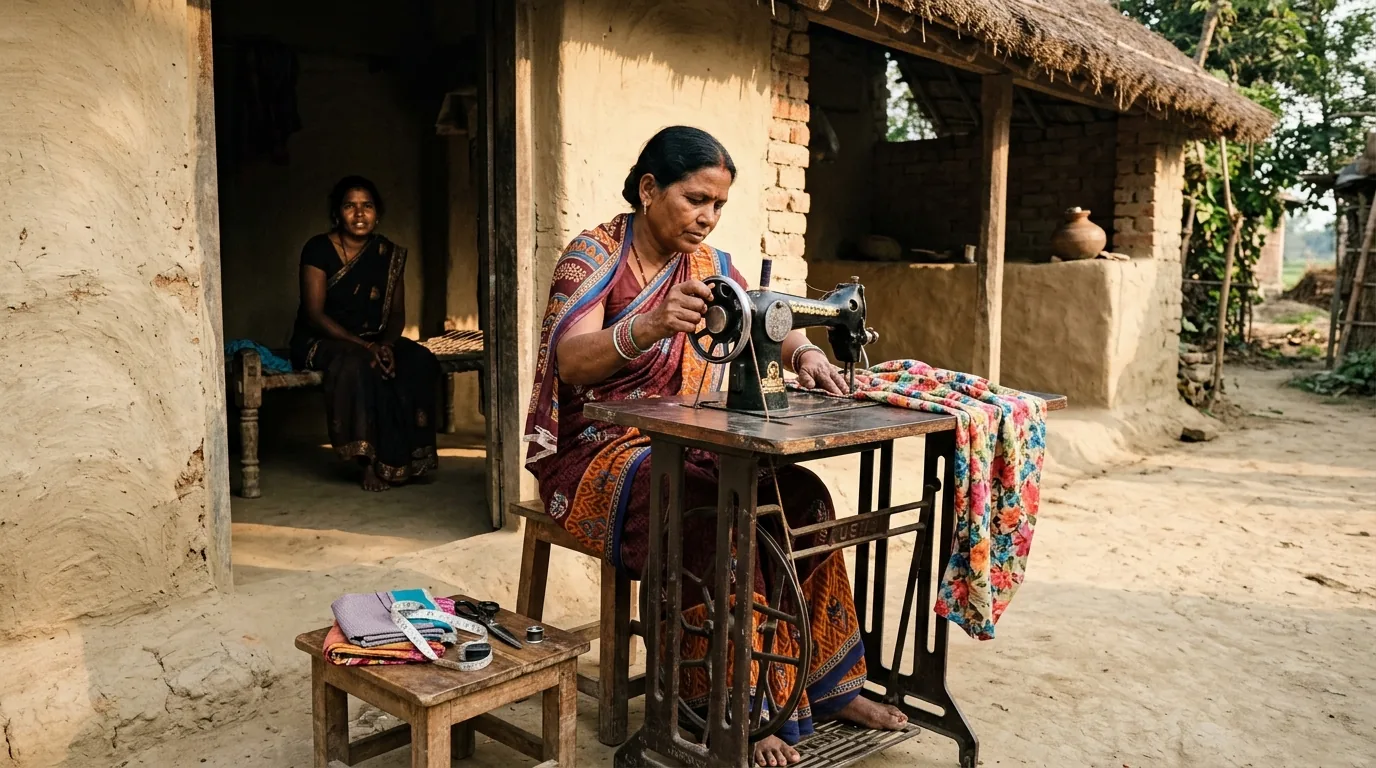
Women's skill training in Nepal turns into a livelihood only when four things arrive together: the course itself, a machine the woman keeps in her own house, a starter kit of cloth and thread, and somebody who comes back three months later to find out whether the machine is being used. Take away any one of them and what you have produced is a certificate and a group photograph. We are a registered non-profit organization in Nepal based in Ganeshman Charnath Municipality, Dhanusha, and we run a women's skill and livelihood programme from here. This is the honest arc of it, including the parts we have not solved.
Why women's skill training in Nepal stalls at the certificate
Most tailoring programmes in the country are built to the same shape, and it is a reasonable shape. A batch of fifteen to twenty women, a trainer, a rented room, a few months of cutting, stitching and finishing, then a completion certificate. Chhimeki Sanstha in Kathmandu, for example, trains twenty women and adolescent girls at a time and has put 122 participants through tailoring in total, ending with a certificate that is meant to improve employability.
The public system runs on the same model. The CTEVT short course for Tailor, Level 2, is 390 hours, roughly three months of daily classes, and where a private centre delivers it the listed fee can run to around Rs 15,000. The Ministry of Labour, Employment and Social Security also offers tailoring among its vocational trades, through training centres at Bhaisepati, Butwal and Itahari. None of those three is in Madhesh Province, which matters more than it sounds: a woman in a Dhanusha village is not going to board for three months in Itahari.
So the course is not the scarce thing. Teaching a woman to cut a blouse and finish a seam is the part of this work that reliably succeeds. The certificate is also where almost every published project page stops, which is why so many of them read the same.
The four things that decide whether she is earning
| What is needed | What happens when it is missing |
|---|---|
| A machine she owns and keeps at home | She practises on a shared machine during the course and then has nothing to work on. Skill decays within months. |
| A starter kit: thread, needles, scissors, measuring tape, first cloth | The first order needs working capital she does not have. Borrowing for it at village interest rates eats the margin. |
| Follow-up after the course ends | Small problems stop her: tension settings, a broken belt, pricing a blouse too low. Nobody is there to answer, and she quietly stops. |
| Buyers within walking distance | She can stitch, but the orders go to the established tailor in the bazaar. A household tailor needs neighbours as customers, not a market twenty kilometres away. |
The fourth one is the hard one, and it is the reason we say plainly that a trade is only worth teaching where it already has local buyers. We made that argument at length in an earlier piece on which trades pass that test in rural Dhanusha, and nothing since has changed our view.
What Madhesh makes harder
The province starts from behind. Madhesh has about 6.1 million people, women are 49 percent of them, and the 2021 census put female literacy at 54.7 percent against 72.5 percent for men, with 31.3 percent of cottage enterprises run by women. A woman here is more likely than the national average to be starting a small enterprise without the reading and arithmetic that pricing and record-keeping assume. That is a training design problem, not a reason to skip her.
It also helps to be clear about what the money looks like. Nepal's statutory minimum wage for a worker is Rs 19,550 a month, set from the start of the 2082/83 fiscal year. Home-based tailoring in a village rarely reaches that, and anyone promising it is selling something. UNDP's account of rural women's enterprises in Chitwan reports women earning between Rs 6,000 and Rs 16,000 a month from wool spinning, alongside roughly 80,000 small entrepreneurs created between 2018 and 2022, 82 percent of them women. That is a different trade in a different district, but the band is realistic: a supplementary income that covers school fees, medicine and festival costs, not a salary.
What a non-profit organization in Nepal can add, and what it cannot
We can supply the course, the venue, the machine and kit where funding allows, and the follow-up visit. We can route a trained woman to the ward office so she knows what registration and public employment support exist. What we cannot do is manufacture demand. Two limits are still open in our women's empowerment and skill training programme:
- Market access. Ready-made clothing is cheap and available in Janakpur and in every weekly haat. A village tailor competes on alteration, blouse and petticoat stitching, school uniforms and repair work, not on volume.
- Seasonal demand. Orders bunch around Dashain, Tihar, Chhath and the wedding months, then thin out. Income from tailoring is lumpy, and a woman who budgets as if it were monthly will be caught out in the slow season. We now say this during the course rather than after it.
We also do not publish beneficiary counts or income figures we have not measured ourselves. Where we have run a cohort, the photographs are on our gallery and the session details on the women's skill and livelihood training event page. Numbers will go up when follow-up data exists, not before.
Frequently asked questions
Is tailoring training free for women in Nepal?
Sometimes. Government-run and NGO-run batches are usually free or heavily subsidised; private CTEVT-affiliated centres charge, and fees around Rs 15,000 for a 390-hour tailor course are normal. Ask who is funding the batch before you apply.
How long does a tailoring course take?
The standard CTEVT short course for Tailor Level 2 is 390 hours, which works out to about three months of daily classes. Shorter community batches exist but cover less.
Do trainees get a sewing machine?
Not automatically, and this is the single biggest predictor of whether anyone is earning afterwards. Ask any programme directly whether a machine goes home with the trainee or stays in the training room.
How much can a village tailor in Dhanusha earn?
We do not have audited figures of our own, so we will not invent a number. Comparable rural enterprise work in Nepal reports a few thousand to around Rs 16,000 a month, well below the Rs 19,550 statutory minimum wage, and it varies sharply by season.
How do I check that an organisation offering training is genuine?
Ask for the registration certificate from the District Administration Office, the latest renewal and the audit report. You can read about our non-profit organization in Nepal and see the causes this charity in Nepal runs, and we have worked with the Ministry of Health and Population, Madhesh Province, on a free cervical cancer screening camp in Ganeshman Charnath–01.
If you want to join a batch
If you live in Ganeshman Charnath or nearby wards and want to be considered for the next women's skill and livelihood batch, put your name down through the course registration form. Tell us whether you already have a machine at home, because that changes what we need to arrange for you. If you are a tailor, a trainer or a shopkeeper who could take finished work from trained women, that is the help we are shortest of, and you can reach us through our contact page.
Leave a comment
Your email address will not be published. Required fields are marked *