
Who Gets a Scholarship From an NGO in Nepal
Most charities publish what they fund and not who they choose, so families in Dhanusha end up guessing. Here is the selection logic we use — school and ward verification, government quota first, payment to the school — and the things that stop an application.
In this article (9)
- Why a small charity in Nepal should publish its criteria
- The government scholarship is claimed before ours
- Charity scholarship criteria: what the support covers
- Why the school and the ward both verify
- How applications are ranked
- What disqualifies an application
- What a family should bring
- Questions families ask
- If a child in your ward is about to stop
If you want to know how a family actually gets a scholarship from an NGO in Nepal, here is the short version of how it works at Shrijanshil Nepal, a non-profit organization in Nepal based in Ganeshman Charnath Municipality, Dhanusha: the school and the ward both confirm the need, any government scholarship the child is entitled to is claimed first, and the support is paid out as fees, books and uniform rather than handed to the household as cash. The rest of this page is the part nobody publishes — how cases are ranked when there are more of them than there is money, and what stops an application dead.
Why a small charity in Nepal should publish its criteria
Search for scholarships for Nepali students and you will find study-abroad marketing and government scheme pages. What you will not find is a Nepali organisation saying plainly who it selects. The result is predictable: parents assume you need a contact inside the office, or that the decision is political, or that there is a fee. None of that is true here, and the only way to prove it is to write the criteria down where anyone can check them against what we actually do.
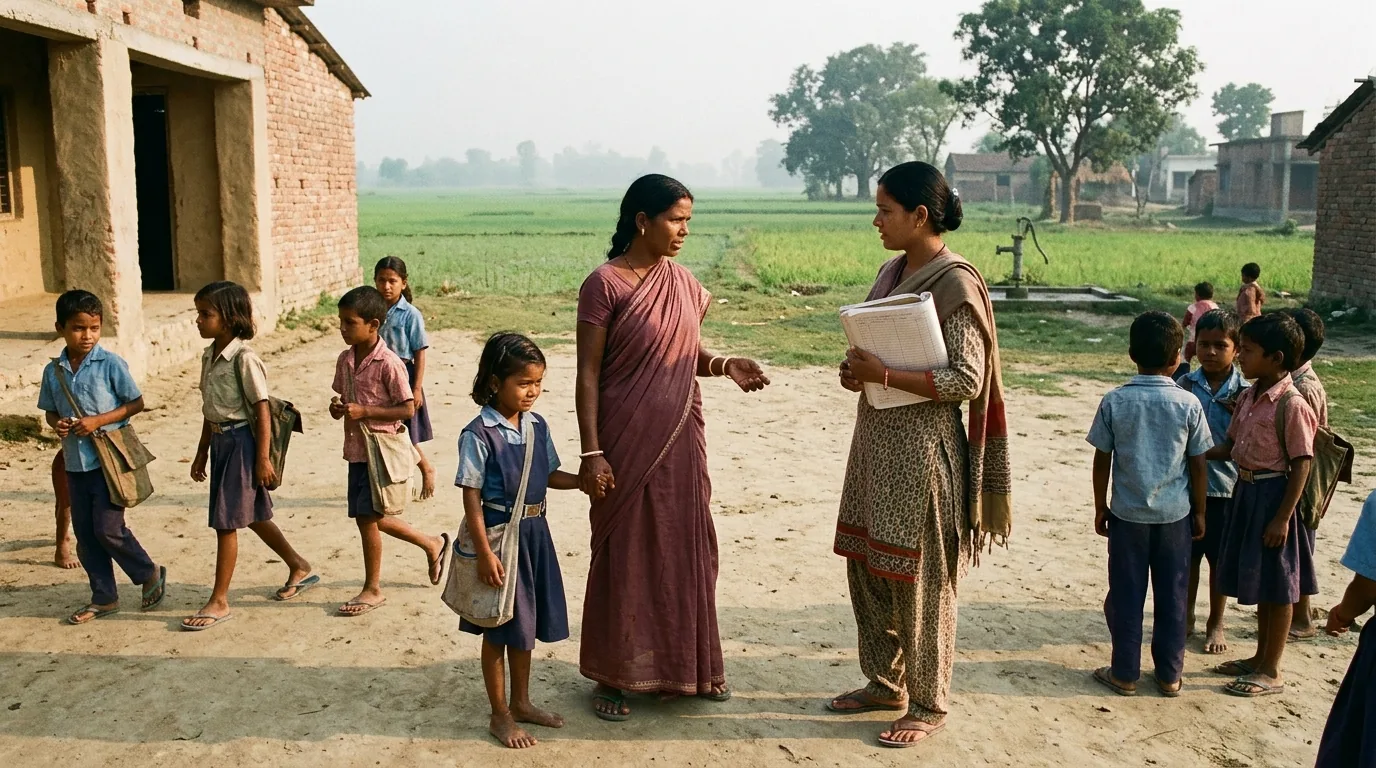
The need is not abstract in this province. The National Statistics Office's report on children from the 2021 census found that in Madhesh Province 14 per cent of children have never been to school and another 5.5 per cent enrolled and then dropped out, against a national average of 5.4 per cent who never enrol. Roughly one child in five is out of a classroom. Almost none of them left because they could not learn.
The government scholarship is claimed before ours
This is the first filter, and it disqualifies more applications than poverty ever does. Nepali law already entitles a child to a good deal, and an NGO grant that duplicates a state entitlement is money wasted on one family that another family needed.
- Basic education is free and compulsory. The Act Relating to Compulsory and Free Education, 2075 (2018) makes education compulsory up to the basic level for every child who has completed four years and has not yet completed 13, and puts that duty on the local level. If a community school is charging a fee it should not be charging, the answer is the municipality's education section, not a charity.
- The 10 per cent free-ship quota in private schools. Institutional schools must give scholarships to at least 10 per cent of their students, prioritising poor, marginalised, female, Dalit and indigenous children. In April 2026 the Ministry of Education told local governments to act against schools that do not comply and to make recipient lists public for parents. If your child is in a private school, that quota is yours to ask for.
- Category scholarships at community schools for Dalit students, students with disabilities and girls, plus the local scholarship management committee that the municipality runs.
We ask every family to check those first, and we will help make the enquiry. Our earlier piece on which government scholarships to claim and how to apply through the school and ward sets out the process in full.
Charity scholarship criteria: what the support covers
The support covers the three costs that actually end a rural child's schooling:
- admission and exam fees, paid directly to the school against its own statement of dues;
- textbooks, exercise books and stationery;
- uniform, shoes and a school bag.
It is never cash to the household, and that is a deliberate rule rather than distrust. A grant that arrives as money competes with every other urgent thing in a poor household in a bad month, and it usually loses. Paying the school leaves a receipt, which means the ward, the head teacher and any donor can trace what was spent on whom — the same paper trail an organisation needs when it reads its accounts out at a public social audit. It also protects the family from the accusation that follows cash around a village.
Why the school and the ward both verify
Two confirmations are asked for, and they answer different questions. The school confirms what we cannot see: that the child is on the roll, roughly how attendance has gone, what is outstanding, and whether the school's own quota has already been applied. The ward office confirms the household — that the family lives where it says it lives and that the recommendation is not being written for a relative of someone at the school.
Either one alone is easy to lean on. Both together are hard to arrange for a case that is not real, which is the entire point. This is also why the school is the right place for a head teacher to raise a name on a family's behalf; teachers usually notice a child slipping before the parents say anything.
How applications are ranked
When there are more verified cases than funds — which is normal — this is the order.
| What we look at | What moves a case up |
|---|---|
| Nearness to leaving | The child is still attending but the fee is due, or the uniform no longer fits. A student who has already stopped for a season is far harder to bring back than one who is short of a uniform. |
| Gap left by the state schemes | The family fits no reserved category, so no quota reaches it — a household whose income collapsed mid-year through illness, death or a lost remittance. |
| Which child the household would sacrifice | When a family is choosing between two children, it is usually the girl who is withdrawn. She is prioritised. |
| Grade transition | The jump from basic to secondary level is where children in this province disappear from the register. |
What disqualifies an application
- No school confirmation, or no ward recommendation.
- A cost that a government scheme or the school's own 10 per cent quota already covers, and which has simply not been asked for.
- A request for cash, or for payment to anyone other than the school or the supplier of books and uniform.
- Any money, gift or commission offered to, or asked by, anyone in connection with the selection. Selection is free. If somebody asks a family for a payment in our name, tell us and tell the ward.
- Costs outside the programme: consultancy fees, foreign study applications, private tuition packages.
What a family should bring
- The child's admission record or most recent mark sheet.
- The birth certificate, or a parent's citizenship certificate.
- A ward recommendation (सिफारिस) from your ward office.
- The school's written statement of what is outstanding.
- A disability card or other category document, if the child has one — it usually opens a government entitlement first.
Nothing here needs an agent, and no document needs to be paid for beyond the ward's own nominal charge.
Questions families ask
Can I apply directly, or must the school apply for me?
Either. Parents approach us and head teachers raise names. In both cases the school's written confirmation is required before anything is decided.
Do we have to be Dalit, Janajati or hold a disability card?
No. Those groups have their own state entitlements and should claim them. This programme exists largely for the families who fall outside every category and therefore outside every quota.
Will the money come to us?
No. Fees go to the school; books and uniform are supplied. You will be told what was paid and can ask the school for its receipt.
Does the child have to be in a government school?
Most supported students are in community schools. If a child is in a private school, we will first push for the 10 per cent free-ship seat the school is legally required to provide.
Is there a fee, or a donation expected, to be selected?
Never. Anyone who suggests otherwise is not acting for this organisation.
If a child in your ward is about to stop
Tell us before the child leaves, not after. Bring the school's statement and the ward recommendation to the office at Ganeshman Charnath, Dhanusha, or send the details through the contact page; school teachers and ward secretaries are welcome to send a list rather than a single name. You can read how our education programme in Dhanusha fits alongside the other causes this charity in Nepal runs, and more about our non-profit organization in Nepal, including where to find us. Another organisation that wants to copy these criteria is welcome to — they are not proprietary, and they work better the more places use them.
Leave a comment
Your email address will not be published. Required fields are marked *