
Free Cervical Cancer Screening in Nepal: Who, Where, Cost
The VIA test is free at government health posts for women aged 30 to 60, recommended every five years, while a private pap smear starts around Rs 1,500. Here is who qualifies, where to go, what the test feels like, and what happens if the result is positive.
In this article (9)
In Nepal, cervical cancer screening by VIA — visual inspection with acetic acid — is provided free of cost at government health facilities for women aged 30 to 60, and the national recommendation is one screening every five years. There is no lab fee, no referral letter and no bill. What costs money is a pap smear or an HPV test at a private clinic, which usually starts around Rs 1,500. If you are a woman between 30 and 60 who has never been checked, free cervical cancer screening in Nepal is available at your nearest health post, and that is where to begin.
Below is what the programme actually covers, what a screening day looks like, what happens if the result is abnormal, and where the free service ends and paid tests begin.
The short answers
- Who: women aged 30 to 60. Younger women with symptoms should still see a health worker, but routine screening starts at 30.
- What: the VIA test — a nurse or doctor applies dilute acetic acid (vinegar) to the cervix and looks for areas that turn white.
- Where: government health posts, primary health care centres and basic hospitals. The VIA test is free at government health institutions in 64 of Nepal's 77 districts for women in that age group.
- How often: every five years if the result is normal, under the national guideline for women aged 30–60.
- Cost: nothing for VIA at a government facility. A pap smear at a private clinic in Kathmandu is commonly around Rs 1,500; HPV DNA testing costs more.
Why the free VIA test exists
Cervical cancer is the second most common cancer among women in Nepal and the leading cause of cancer deaths among women. In 2022 the country recorded an estimated 2,169 new cases and 1,313 deaths. Almost all of it is preventable, because the disease takes years to develop from a precancerous lesion, and a lesion caught early can be treated in a single visit.
The government's response was to choose a test that works without a laboratory. Nepal's Cervical and Breast Cancer Screening Program Implementation Guideline puts VIA at the front line: a trained nurse, a speculum, a light and vinegar. Nothing is sent away, and the woman gets her result before she leaves the room. Budget for the screening programme has been allocated across all 753 palikas.
Uptake, though, remains the weak link. By 2019 only 8.2 percent of women aged 30–49 had ever been screened, against a national target of 70 percent. Most women who have never had a VIA test are not refusing it — they simply have not been told it exists, or do not know it is free.
Free VIA versus a paid pap smear or HPV test
| Test | Where | Typical cost | Result time |
|---|---|---|---|
| VIA (acetic acid) | Health post, primary health care centre, basic hospital, screening camp | Free at government facilities | Same visit |
| Pap smear | Private hospital, polyclinic, diagnostic centre | From about Rs 1,500 in Kathmandu; higher with a package | Several days (lab) |
| HPV DNA test | Private and specialist clinics | More than a pap smear; varies by provider | Several days (lab) |
A pap smear is not a better version of the free test in every way — it is a different test with a different workflow. It needs a cytology laboratory, a trained pathologist and a second visit to collect the report, which is precisely why the public system did not build the national programme around it. VIA is not perfect: its sensitivity is reported at 73 to 85 percent with specificity of 81 to 89 percent. But a good-enough test a woman actually receives protects her far more than a better test she never takes.
Where to go, and why you should call first
On paper, VIA belongs at every health post. In practice, availability is uneven. A national survey of 572 health facilities found that only 134 (23.42 percent) had a provision for cervical cancer screening; of those that did, 83.58 percent offered it free of charge and 90.30 percent had staff trained in VIA. Training in the follow-up procedures is much thinner — 6.72 percent had someone trained in colposcopy and 3.73 percent in LEEP.
What that means for you, practically:
- Ask at your ward office or the health post itself whether VIA is being done and on which days. Many facilities run it on fixed days when the trained ANM or staff nurse is present.
- If your local health post does not offer it, ask for the nearest primary health care centre or basic hospital that does.
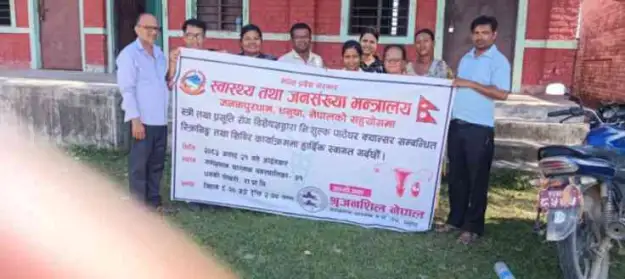
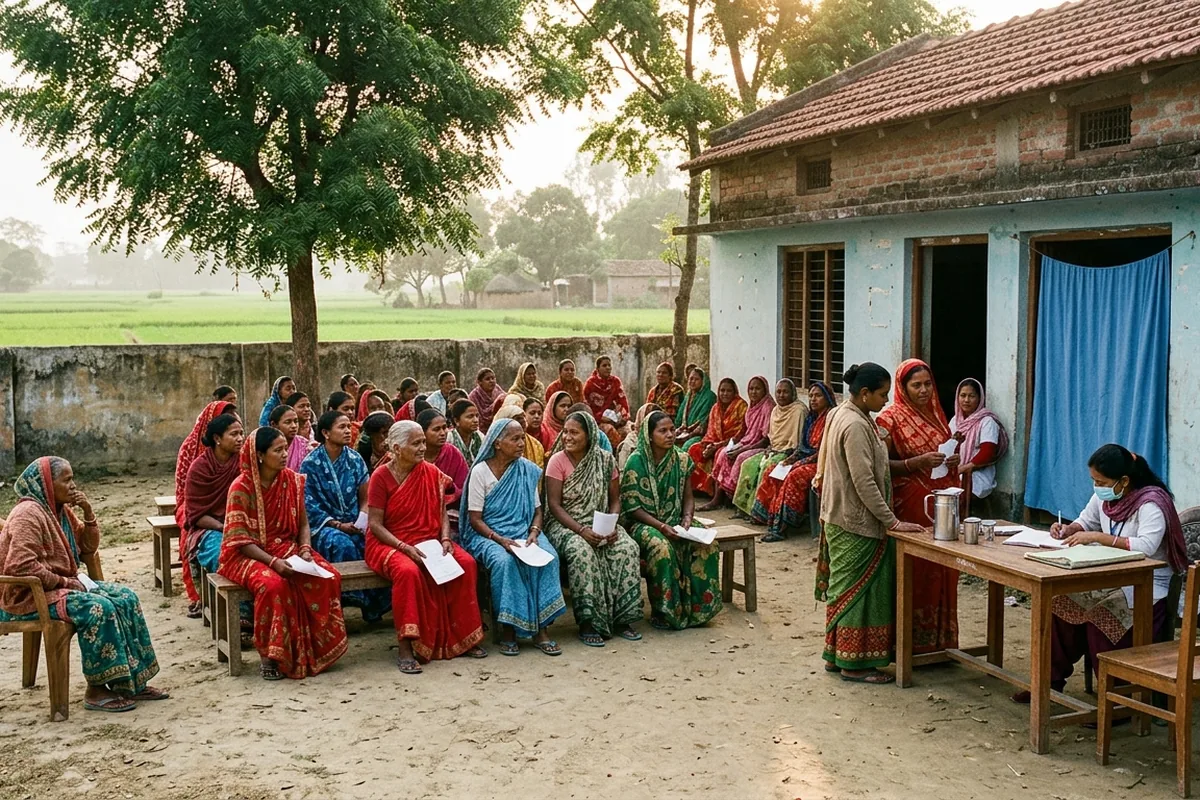
- Watch for screening camps. A camp brings gynaecologists and equipment to the ward, so women who would otherwise travel to a district hospital can be screened close to home. Shrijanshil Nepal organised one such free camp at Dhanki Pokhari, Ganeshman Charnath–01, with support from the Ministry of Health & Population, Madhesh Province, led by specialist gynaecologists.
- Private and non-profit providers such as Marie Stopes Nepal also offer VIA and treatment, on a paid basis.
What the test is actually like
Women hesitate because nobody explains the procedure to them, so here it is plainly. You lie on an examination table. The provider inserts a speculum, the same instrument used in an ordinary antenatal check, and swabs dilute acetic acid on the cervix. After about a minute she looks for any patch that has turned white. That is the whole test. It takes a few minutes, needs no injection and no anaesthesia, and there is usually mild pressure rather than pain.
Some practical points worth knowing: do not schedule it during your monthly bleeding, avoid intercourse or vaginal medication for a day or two beforehand if you can, and ask for a female provider and a curtain if privacy is your concern — embarrassment and lack of privacy are among the most commonly reported reasons women skip screening, and any decent facility will accommodate the request.
If the result is VIA-positive
A positive VIA does not mean cancer. In most cases it means a precancerous change that can be treated before it ever becomes cancer. Standard management under the national programme is early treatment of the lesion — commonly cryotherapy, which freezes the abnormal area and can often be done at the same visit or shortly after — with referral to a higher centre for colposcopy, biopsy or LEEP where the lesion is large, unclear, or suspicious.
Because relatively few facilities have colposcopy- or LEEP-trained staff, the referral step is where women get lost. If you are told your result is positive, do three things before you leave: get the result and referral written on paper, get the name of the hospital you are being sent to, and get a date. Ask a family member, an FCHV or a local organisation to help you follow it up. An untreated positive result is the one outcome the entire free programme is designed to prevent.
The HPV vaccine, and who it protects
Screening finds disease early; the HPV vaccine stops it from starting. In February 2025 Nepal ran a nationwide campaign that vaccinated over 1.46 million girls with a single dose, reaching 94 percent coverage, and the vaccine is now part of the routine national immunization schedule for grade 6 girls and out-of-school 10-year-olds. If your daughter was vaccinated, that protects her generation. It does not replace screening for you: women already past vaccination age still need the five-yearly VIA test.
Frequently asked questions
Is cervical cancer screening really free in Nepal?
Yes, for the VIA test at government health facilities for women aged 30 to 60. A pap smear or HPV test at a private clinic is not free. If a government facility asks you to pay for VIA, ask why — free provision is the programme's stated design, and the survey data show most facilities offering screening do provide it free.
At what age should cervical cancer screening start in Nepal?
Routine screening starts at 30 and continues to 60 under the national programme. Marie Stopes Nepal advises VIA for women aged 30 to 49, and from 25 for women living with HIV, who need it more often. Any woman with bleeding after intercourse, bleeding between periods, bleeding after menopause or a persistent foul-smelling discharge should be examined at once, whatever her age.
How often do I need the VIA test?
Every five years if your result is normal, under the national guideline for women aged 30–60. Some providers advise a shorter interval, and a woman who has been treated for a lesion or is living with HIV will be given her own follow-up schedule. Follow the interval your provider gives you.
What is the difference between VIA and a pap smear?
VIA is a visual examination with vinegar that gives an answer immediately and needs no laboratory. A pap smear takes a sample of cervical cells and sends it to a cytology lab, so it needs a second visit and a fee. Both are looking for the same thing: cell changes before they turn into cancer.
Can I get screened if I am pregnant or have had a hysterectomy?
Tell the provider either way and let them decide. Screening decisions during pregnancy and after surgery depend on your history and on what kind of hysterectomy you had. This article is general information, not a medical opinion — a nurse, doctor or your local health post should make the call for your situation.
If you want this in your ward
The gap in Dhanusha is not the price of the test. It is that a woman in a rural ward often does not know the test exists, is free, and takes five minutes. If you would like a screening or health awareness activity in your ward, or you can help spread the message among women in your tole, get in touch with Shrijanshil Nepal. You can also see what we run through our health and community services and follow upcoming activities on our events page. For anything about your own health, speak to your health post or a qualified doctor first.
Leave a comment
Your email address will not be published. Required fields are marked *