
Environment NGO Tree Plantation in Nepal: The Hard Part
Planting is the cheap part. A Mongabay visit found roughly 10% of saplings surviving at a site where 80% was reported. What a plantation day in the Terai actually has to fund — guards, watering, a named household, and a count nobody usually publishes.
In this article (6)
If you want to judge an environment NGO in Nepal by its tree plantation work, do not count saplings on the day. Count what is still alive two monsoons later. Those two numbers are rarely close. At a Nepal Army plantation inside Ban Devi community forest, where 72,000 saplings went into the ground between 2016 and 2024, an army spokesman put survival at 80% across project sites; when a Mongabay reporter walked the site in October 2025, roughly 10% of the saplings appeared to be surviving.
Shrijanshil Nepal is a non-profit organization in Nepal registered in Dhanusha and working in Ganeshman Charnath Municipality, Madhesh Province. We hold plantation days here. This article is about the part of that work that does not photograph well, because it is the part that decides whether anything is standing in five years.
The gap between planted and alive
The Ban Devi case is worth reading in full because the explanation is mundane. The chair of that community forest told Mongabay that once the army stopped monitoring, the plantation area was completely destroyed. Nothing exotic killed the trees. Attention ended, and the site went back to being open ground.
The scale around that failure is public. Nepal's government tree-planting programme puts roughly 160,000 saplings in the ground a year at a cost of about US$2,000 per hectare, according to the same reporting. In June 2025 the Ministry of Forests and Environment announced the Sagarmatha Tree Plantation Mega Campaign, a 20-year programme running to 2045 with planting each year between Asar 14 and Saun 15. The decision says the saplings planted will be protected. How, by whom and on whose budget is the question every participating ward, school and NGO then has to answer locally.
Madhesh has a direct stake in this. The President Chure-Terai Madhesh Conservation Area Programme, running since 2067/68 BS across 36 districts, exists because the Chure hills above our plains hold the groundwater our tube wells draw from; the government allocated NPR 1.91 billion to it in 2021. Plantation is the most visible slice of that effort, and the easiest slice to do badly.
Why saplings die in the Terai, specifically
The monsoon here is generous, which is exactly what fools people. A sapling planted in Asar looks healthy through Bhadra. It is Chaitra and Jestha that kill it, eight to ten months after the visitors have gone home. The recurring causes in this district are not mysterious:
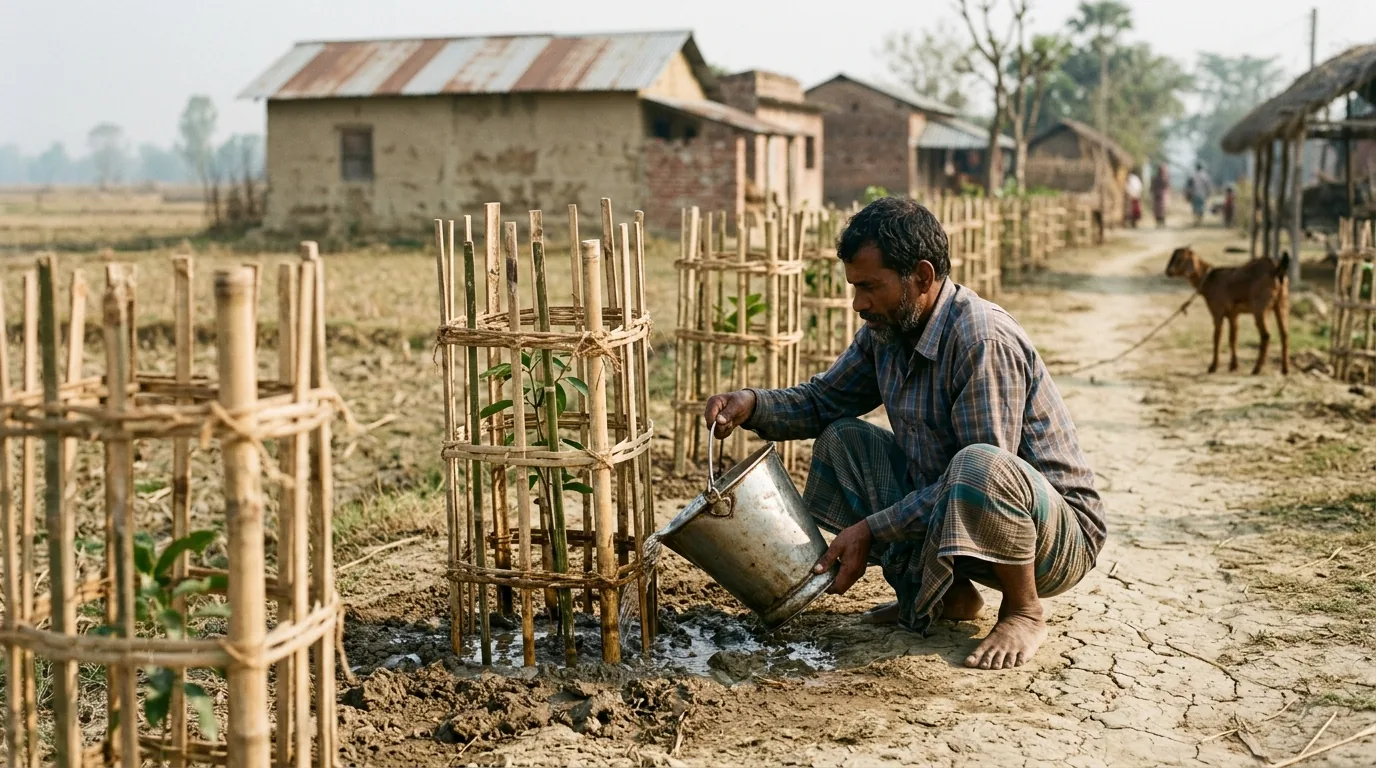
- The first dry season. A sapling needs water through its first two hot seasons. If the nearest hand pump is 300 metres away and nobody is named or paid to carry the bucket, it does not get watered.
- Livestock. Goats and free-roaming cattle strip an unguarded sapling within weeks on any roadside, school boundary or embankment in the Terai.
- No tree-guard, or a tree-guard nobody repairs. A bamboo cage costs more than the sapling inside it. Budgets that count only saplings therefore buy failure cheaply.
- Species chosen by the donor, not the site. A fast-growing exotic on a waterlogged or saline patch is a dead tree with a certificate.
- No named owner. "The community will look after it" means nobody will. A household, a school caretaker or a forest user group with a name attached is a different outcome.
Protection usually beats planting
This is the uncomfortable finding for anyone whose programme is built around planting events. Nepal's forest cover nearly doubled from about 26% in 1992 to 45% in 2016, and NASA's Earth Observatory account of that recovery credits natural regeneration under community management rather than mass planting. Community forests now cover around 2.3 million hectares, managed by more than 22,000 user groups. One community forest chair quoted by Mongabay described sal, sisau and simal growing back on their own within three to four years once grazing and cutting were controlled; a forestry researcher in the same report put it plainly — protect the land and the forest returns by itself.
Planting earns its place where regeneration cannot happen unaided: a bare school compound, a canal bund, a degraded roadside, private farmland where a family wants fruit or fodder. Where it works, it is because people were consulted and paid. In a Gandaki project documented by Mongabay in July 2025, 131,186 trees of 44 native species went onto about 76 hectares between 2010 and 2016, with community forest groups picking species by soil type and economic use and community members drawing a monthly nursery salary.
What an environment NGO in Nepal tree plantation day really costs
The sapling is the cheapest line in the budget. A plantation day priced honestly looks like this:
| What is needed | When | Usually funded? |
|---|---|---|
| Saplings, pits, planting labour | Asar–Saun | Yes — this is what gets sponsored |
| Tree-guard or fencing against livestock | Day one | Often skipped |
| Watering through the first two dry seasons | Chaitra–Jestha, twice | Rarely budgeted |
| A named household or group per block of saplings | Agreed before planting | Rarely written down |
| Replacing dead saplings | Next monsoon | Almost never |
| A physical count at 12 and 24 months | Year one and two | Almost never published |
Any organisation, ours included, that cannot say who is doing rows two to six is running an event, not a plantation.
How this non-profit organization in Nepal runs a plantation day
What we can state plainly: our environment and tree plantation programme runs drives with local students and volunteers in Ganeshman Charnath, combined with awareness sessions on protecting the local environment, and our Community Tree Plantation Day is organised with the ward and the participating school rather than around them.
What we will not state is a survival percentage. We have not published a verified 12-month count, so we do not quote one. An organisation that cannot show you its counting method is quoting a hope. That is the whole argument of this article, and it applies to us first.
If your ward, school or forest user group wants a plantation day, come to the conversation with four answers ready, because they decide everything that follows:
- Where is the water in Chaitra, and who carries it?
- What is grazing on that land now, and what stops it?
- Which species does your nearest Division Forest Office or community nursery recommend for that exact soil?
- Whose name goes against each block of saplings?
You can see what else the causes this charity in Nepal runs cover, and read about our non-profit organization in Nepal, including where we are based and how to verify our registration before working with us.
Questions people ask
When is the right time to plant trees in Nepal?
With the monsoon. The government's Sagarmatha campaign sets the national planting window at Asar 14 to Saun 15 each year through 2045. In the Terai, planting outside that window without irrigation is close to pointless.
Which species should be planted in the Terai?
Ask the Division Forest Office or the nearest community forest nursery about your soil rather than copying a list from a website. Sal, sisau and simal regenerate naturally across much of the Terai when land is protected — itself a hint that protection is the cheaper intervention on degraded forest land. Fruit and fodder species make more sense on private farmland, because the household has its own reason to water them.
Is it better to fund planting or protection?
Nepal's own record favours protection. Forest cover roughly doubled under community management, largely through natural regeneration. Fund planting where there is nothing left to regenerate, and fund the guards, the watering and the follow-up counts rather than the sapling count alone.
Why do so many NGO plantation drives fail?
Because the budget, the photographs and the reporting all end on day one. Ban Devi is the clearest documented case: 80% survival reported, roughly 10% observed on the ground, and the collapse dated by the community forest chair to the moment monitoring stopped.
Can a school in Dhanusha request a plantation day?
Yes. Schools and ward offices can approach us directly. We will ask the four questions above before fixing a date, and if the answers are not there we will say so instead of planting anyway.
If you live in or near Ganeshman Charnath and want a share of the unglamorous half of this work — the watering rounds, the guard repairs, the 12-month count — join as a volunteer. That is the help this programme is actually short of.
Leave a comment
Your email address will not be published. Required fields are marked *